Sensing a room
Written 27 September 2026 · Published 16 October 2026
With Cornelius O, I am developing a performance in which information about a room returns to performers as language. The March proposal brought together pose studies, a sensing console and performer writing. A returned cue might be spoken, resisted, echoed or ignored; that choice is the part I want to keep open.
In experiments during boycow rehearsals and YOLOROBICS, I used depth and regular cameras to extract poses. A screen displayed charts and readouts, while auditory cues relayed movement, stillness and the system’s interpretations of attention and distraction. We tried situations where performers faced away from the audience or the room was foggy, using sound to convey the audience’s spatial arrangement.
Some performers found the extra information confusing. Others, after becoming familiar with it, experienced it as an extension of their senses. I want to explore whether visual augmentation could feel more intuitive; a head-mounted display is a possible next step.
Scylla and Charybdis give the proposal two pressures to navigate: rigid instructions and overwhelming flux. The prototype below uses synthetic participants to test spatial relationships.
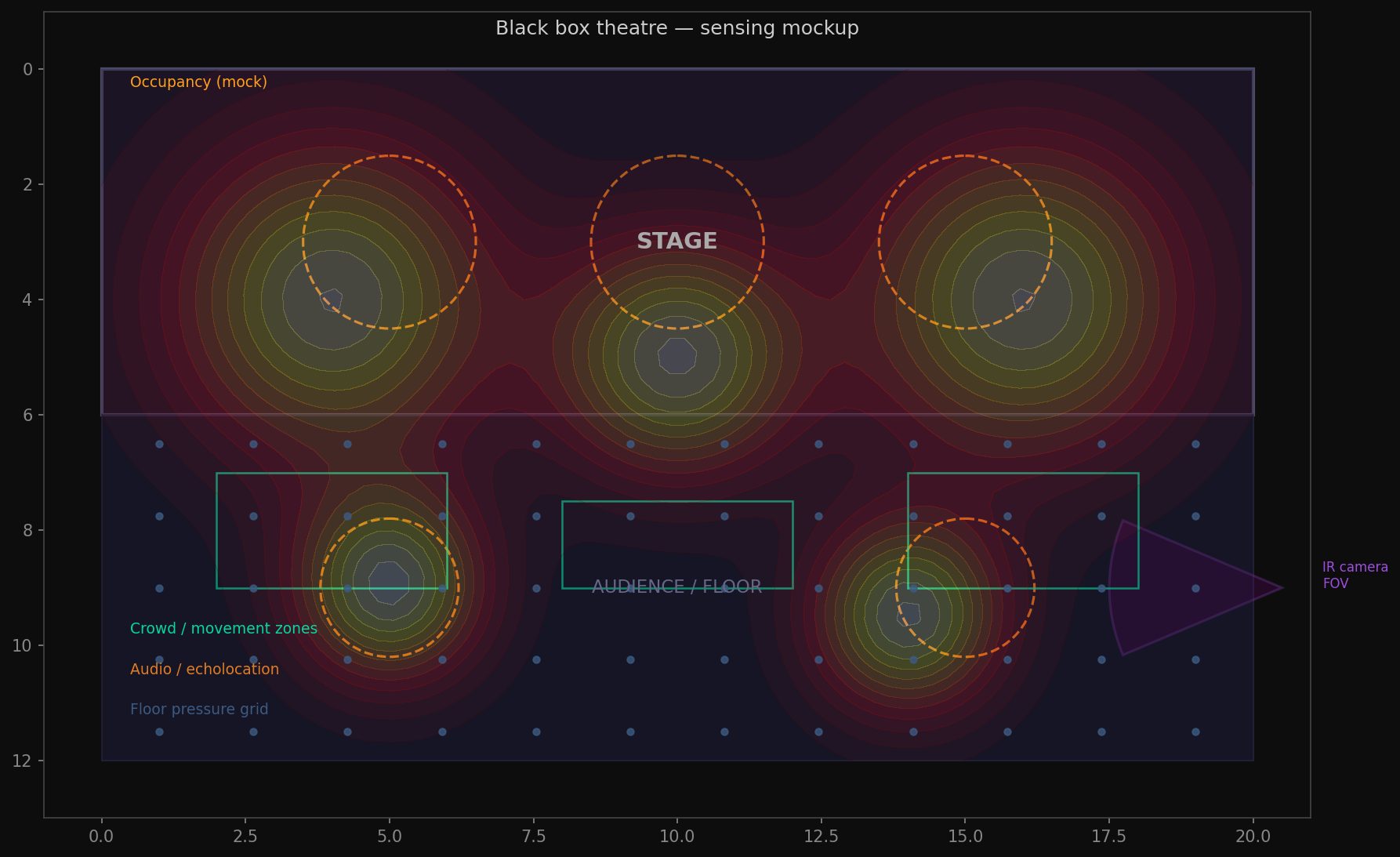
Recovered simulation, reviewed September 2026. Synthetic positions and data; its exact version in the March proposal is unconfirmed.