[ field log ]
※ Planetary Scheduling in Practice
Field Log - in progress / studio note
A task and calendar tool built around planetary hours and variable capacity
Context
Conventional productivity systems assume consistent capacity. I do not have it. A calendar can show that two hours are empty without knowing whether I can use them, whether I am recovering, or whether the task belongs to that part of the day.
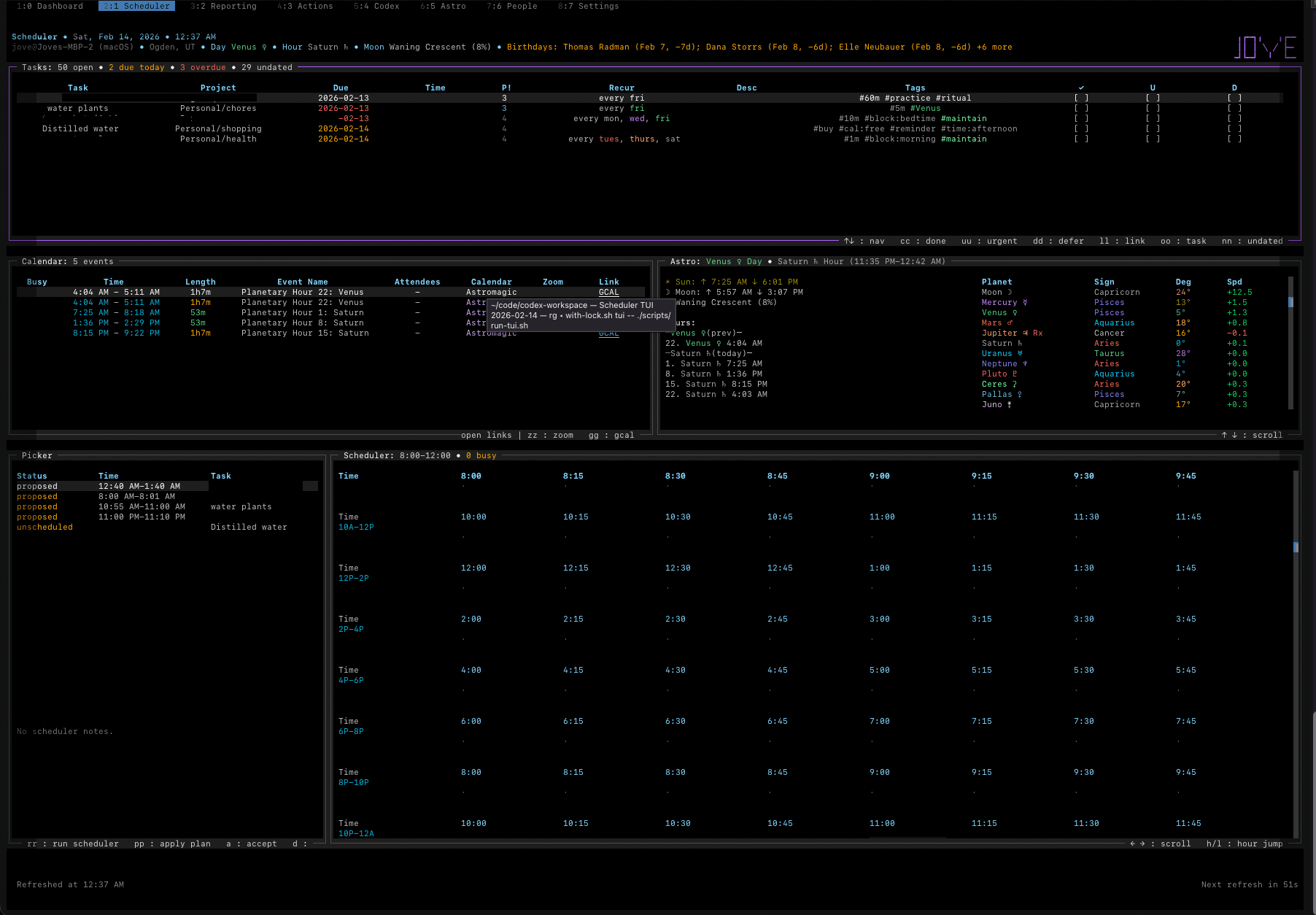
I built the codex-workspace scheduler to make time less interchangeable. The current tool brings Todoist tasks, Google Calendar events, routine blocks, planetary hours, and daily astrological weather into one terminal interface. It proposes a day, then leaves the judgment with me.
What Is Actually Working
The working scheduler currently uses:
- Todoist tasks, labels, due times, and estimated durations
- Google Calendar events and explicit busy or available routine blocks
- Planetary days and hours calculated with the astrotechne core library
- Daily astrological weather, including planetary positions and lunar phase
- Local urgent, defer, accept, and reject decisions
Tasks with a planetary label can be placed where they overlap most closely with the relevant planetary hour. A task with a fixed due time keeps that time. Busy routine events remain blocked, while available routine windows can receive work. Nothing is silently committed: the scheduler writes a proposal that I can inspect, change, or refuse.
What It Does Not Know
The workspace also has separate pipelines for HealthKit, sleep, Screen Time, and activity reports. Those measurements are stored for review; they do not currently drive the scheduler. The tool does not infer my emotional state, detect burnout, inspect banking activity, or decide that a transit caused a period of focus.
That boundary matters. The current accessibility features are modest and explicit: routine blocks, time-of-day labels, task durations, manual deferral, protected unavailable time, and the ability to reject a plan. They help me represent variable capacity, but they do not measure it for me.
What the Planetary Layer Is For
The planetary layer comes from my ritual practice. Planetary days and hours give the week texture: Mars for force and difficult action, Mercury for writing and exchange, Saturn for limits, maintenance, and endings. A Saturn hour does not issue an order. It offers a character for the hour and a question about what kind of work belongs there.
I find that more useful than a calendar made entirely of identical rectangles. The value is interpretive. It helps me notice timing, resistance, and desire without pretending the symbolism is an objective productivity score.
Current Observations
The most useful part of the prototype is seeing tasks, calendar commitments, routine, and astrological time on the same screen. Conflicts become obvious. Unscheduled tasks remain visible instead of disappearing into a list. Planetary placement can produce a useful suggestion, but manual overrides remain essential.
The least useful version is the most automated one. When the tool presents too many interpretations as decisions, I stop reading them. The scheduler works best as a reflective surface: opinionated enough to propose a shape for the day, limited enough to accept no.
Ethical and Practical Constraints
Most scheduler state and configuration remain local, but the system is not sealed: tasks come from Todoist and events come from Google Calendar. Personal metrics stay in a separate local reporting pipeline. Any future connection between those metrics and scheduling should be opt-in, legible, and easy to disable.
Current Limitations
- Health and activity metrics are not connected to scheduling decisions
- Capacity must still be represented manually through blocks, labels, and overrides
- Configuration remains high for a personal tool
- Planetary task placement is intentionally simple
- Symbolic overfitting remains an obvious temptation
Next Steps
The next useful step is not a grand predictive model. It is a clearer way to record capacity, compare a proposed plan with what actually happened, and learn without turning the body into another performance metric.
I built this because time is not neutral for a disabled body or for a ritual practitioner. The calendar should be honest about both.